Cref
How CREF Cut Administrative Effort in Half and Strengthened Client Decision-Making with Spiky
Headquarters
Boston, GA, USA
Founded
2016
Employees
51 - 200
Industry
Strategic Real Estate Solutions that Enable Healthcare
The Company
CREF is a U.S.-based strategic advisory and owner’s representation firm that supports clients, primarily in healthcare and complex capital projects, through high-stakes decision-making. The firm helps organizations plan, document, and execute large-scale initiatives by synthesizing information from multiple stakeholders. As CREF’s work grew more complex, clear meeting documentation and structured communication became essential to maintaining alignment, driving decisions, and delivering value to clients.
The Challenge
CREF’s work relies heavily on meeting notes, agendas, and follow-ups to guide both client decisions and internal operations. Over time, maintaining consistent, high-quality documentation became increasingly difficult. Team members varied in how they captured and structured notes, and important details from technically dense conversations were sometimes lost.
Each client meeting triggered a heavy administrative workflow: agenda preparation, live note-taking, drafting and validating meeting minutes, organizing documentation, and distributing summaries to stakeholders. What should have been a one-hour meeting often took up to four hours.
This inefficiency slowed operational decision-making, created gaps in shared understanding, and made it harder for teams to move from discussion to agreement, especially in projects that required multiple meetings to reach alignment. Without a reliable system to capture and synthesize information, teams risked revisiting the same topics repeatedly and reacting instead of executing.
The Outcome
Spiky transformed how CREF captures, synthesizes, and acts on information from client and internal meetings. By automating meeting summaries and surfacing structured insights, Spiky reduced the administrative effort required per meeting by nearly 50%, cutting what was once a four-hour process down to roughly two hours.
Instead of reconstructing context after meetings, teams now enter follow-ups fully informed, with clear documentation of decisions, action items, and next steps. This shift accelerated operational alignment, improved accountability, and enabled faster, more confident decision-making across the organization.
Beyond efficiency, Spiky introduced a new level of clarity and transparency. With everything clearly documented, there is less ambiguity around ownership and outcomes, allowing teams to focus their time on the right priorities. CREF now engages clients with greater accuracy, responds more effectively to complex discussions, and demonstrates in practice what it means to work smarter, not harder.
Introduction
For CREF, information is the business.
As a strategic advisory firm providing owner’s representation services, CREF is hired to ensure clients can make informed decisions. Every meeting matters. Every detail counts. And every missed insight can slow down projects involving millions of dollars, strict timelines, and multiple stakeholders.
Over time, however, CREF began to feel pressure in a familiar place: meeting documentation capacity.
While the firm’s work relied heavily on structured notes, agendas, and follow-ups, the internal ability to consistently produce high-quality meeting records was declining.
The result was clear:
- More time spent recreating context after meetings
- Slower operational decision-making
- Increased risk of critical details being lost in complex conversations
Challenges Before Spiky
CREF’s challenges weren’t about selling faster. They were about thinking clearly and executing effectively in an increasingly complex environment.
Key Challenges
- Inconsistent note-taking quality
- Heavy administrative workload per meeting
- Slower operational decision-making
- Information loss in complex conversations
Historically, junior team members learned the business by taking detailed notes. Over time, that expectation eroded. Newer employees were less inclined to take structured notes, and documentation quality varied widely across projects.
This inconsistency created gaps in how information was captured and shared—especially when compared to competitors who were more operationally organized.
The Administrative Burden of Every Meeting
Each client meeting triggered a long chain of work:
- Agenda preparation
- Live note-taking
- Drafting detailed meeting minutes
- Circulating notes for validation
- Organizing and filing documentation
For a single meeting, this process could take up to four hours.
CREF operates as a collaborative advisory firm, where decisions require alignment across teams. Without clean, shared understanding from prior meetings, teams frequently revisited the same topics—slowing momentum.
Understanding, the prerequisite for agreement, became harder to achieve without structured, accessible documentation.
Adding to the challenge, CREF works on technically dense projects, including hospital construction and infrastructure initiatives. Important context, risks, and next steps were easy to miss in long, complex discussions.
Discovering a Smarter Way to Work
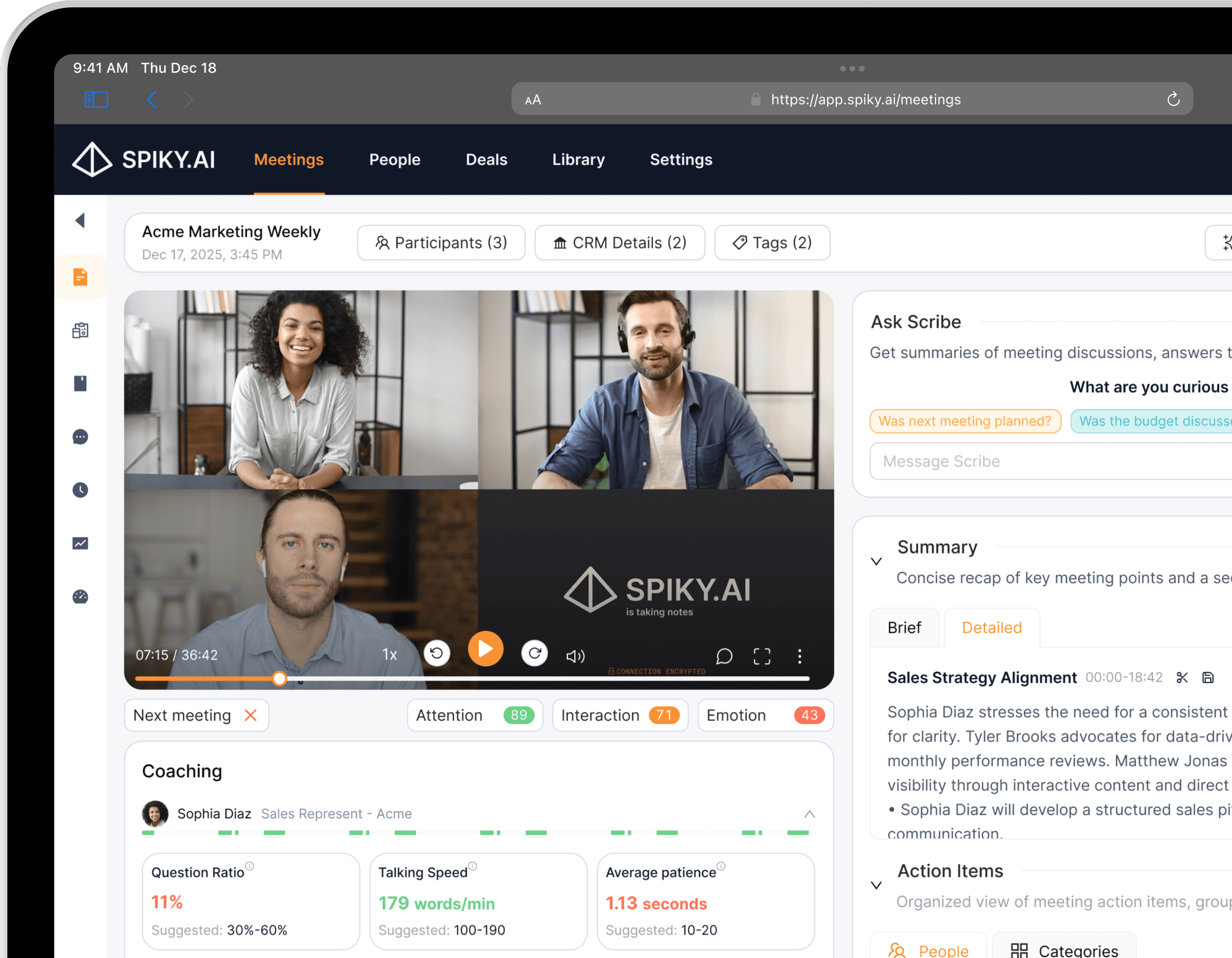
When CREF began using Spiky, the appeal was immediate: AI-powered synthesis, not just transcription.
Unlike basic recording tools, Spiky could:
- Capture conversations
- Extract key insights
- Summarize discussions clearly
- Track decisions, next steps, and action items
This allowed CREF to leapfrog a staffing and process challenge—without adding assistants or junior project managers dedicated solely to note-taking.
Spiky allows us to collect a lot of information, synthesize that information, and do our job better.
Patrick Murphy
Regional President, CREF
Instead of recreating conversations after meetings, teams could focus on advising, aligning, and executing—the work clients actually hired CREF to do.
What Changed for CREF
Key Outcomes
- Administrative time cut in half
- Faster, higher-quality operational decisions
- Greater accountability and transparency
- Stronger client engagement
By automating meeting documentation and synthesis, CREF reduced the administrative workload tied to each meeting by approximately 50%.
What was once a four-hour process—preparation, note-taking, drafting, validation, and organization—became closer to two hours total.
With structured summaries and clear documentation:
- Teams entered follow-up meetings aligned and informed
- Prior discussions didn’t need to be rehashed
- Momentum shifted toward agreement and execution
Spiky eliminated ambiguity, and with it, unnecessary back-and-forth.
A Cultural Shift Toward Accountability
One unexpected shift was cultural.
With decisions, next steps, and ownership clearly documented, there was far less room for ambiguity or “plausible deniability.” While initially overwhelming, this transparency helped teams focus on the right priorities and work more deliberately.
CREF’s consultants could revisit conversations with full context, ensuring accurate responses to client concerns—even when discussions were complex or emotionally charged.
As Patrick noted, Spiky allowed the team to listen fully in the moment, knowing critical details wouldn’t be lost afterward.
The Results: Metrics & ROI
- ~50% reduction in administrative time per meeting
(From ~4 hours → ~2 hours total effort) - Faster internal alignment and decision-making
Teams arrive informed, reducing repetitive discussions - Improved documentation quality across the organization
Structured summaries replace inconsistent manual notes - Higher accountability and follow-through
Clear tracking of decisions and next steps - Better client responsiveness
No lost context, even in complex, technical discussions
A New Rhythm for Advisory Work
Today, Spiky is embedded in how CREF works.
Meetings are no longer followed by hours of reconstruction. Teams don’t scramble to remember what was said or what was agreed upon. Instead, they move forward with clarity, confidence, and shared understanding.
What began as a solution for note-taking evolved into something much bigger:
A way to work smarter, not harder.
We don’t just talk about working smarter—this proves that we actually walk the walk.
Ready to get elevated?
Embark on your meeting optimization journey with Spiky today. Sign-up to empower your connections.
Try it for free