Enterprise & Regulated Deployment
On-premise deployment
Run Spiky entirely inside your own environment
Deploy Spiky inside your own infrastructure. Recordings, transcripts, and insights never leave your environment.
Keep every conversation inside your perimeter
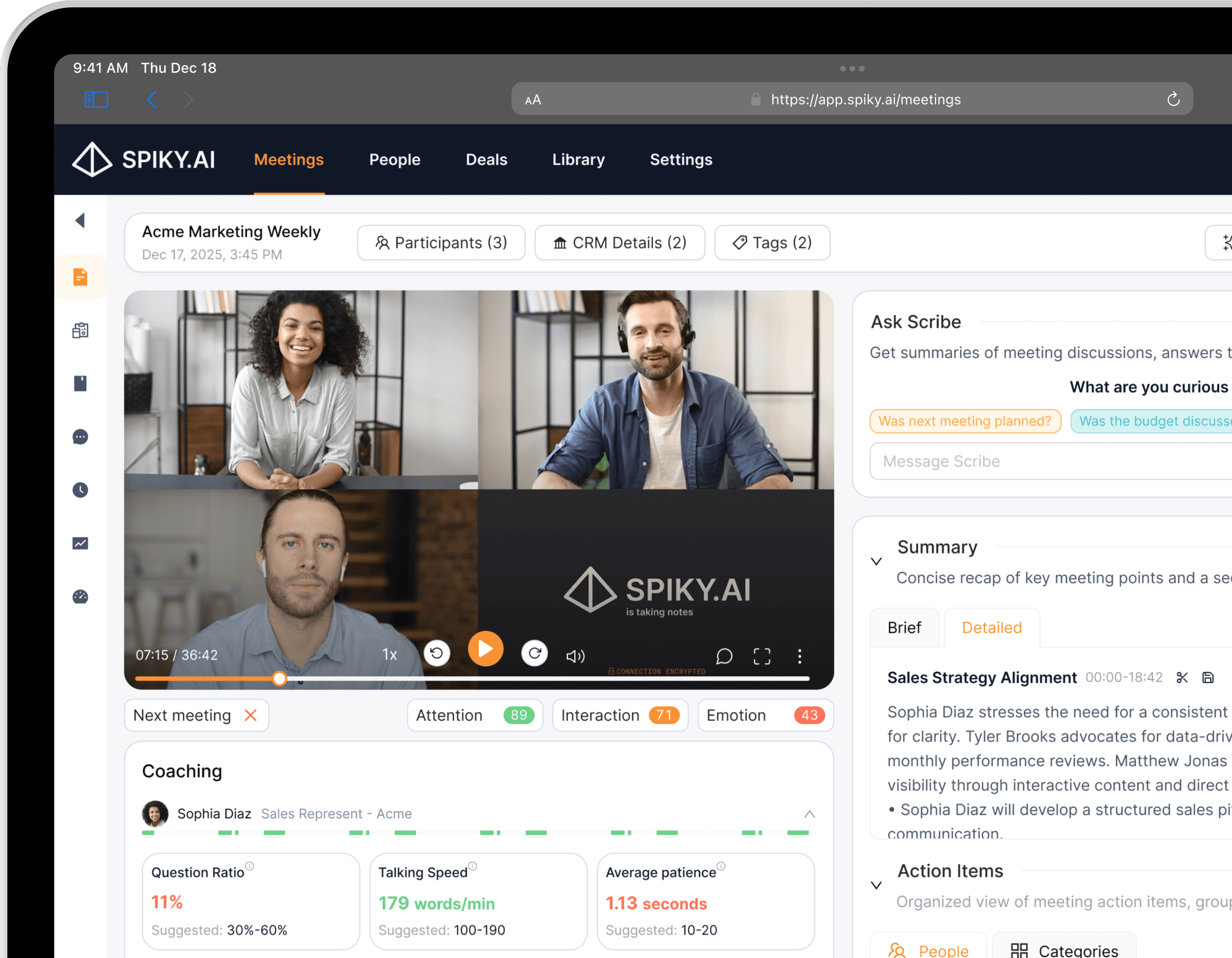
On-premise Spiky is built for organizations that can’t use the cloud for reasons of data sovereignty or regulation. You get the full product — capture, transcription, summaries, and Signals — without any conversation data leaving your environment.
Your data never leaves your environment
The only outbound connection is the meeting bot joining your conferencing platform, just like a participant. Recordings are taken inside your environment and written to your own storage — Spiky components never send data to the cloud.
Runs in your infrastructure
Every component is containerized, stateless, and Kubernetes-compatible, and maps to your existing enterprise architecture stack — database, queue, and object storage included.
Use your own AI models
Spiky connects to the language and speech-to-text services you already run, through an OpenAI-compatible endpoint you control — and if needed, we can help deploy models on your side too.
Your security and compliance stack
TLS everywhere, encryption at rest with your KMS, role-based access, audit logs, and configurable retention — reviewed and approved by your security team before go-live.
A layered, phased deployment
Spiky on-premise is split into two independent layers, so you can start small and expand as your security team gets comfortable.
Layer 1 — Recording & Bot
Captures meetings inside your environment using CPU only — no GPU required. It’s the simplest, fastest layer to deploy and the recommended starting point, because data stays in your perimeter from day one.
Layer 2 — Processing & LLM
Transcribes recordings and generates summaries, action items, and insights using your model services. This layer runs on GPU on your side, sized to your expected parallel-processing load.
Bring your own models
Spiky consumes the models your organization already serves — through an OpenAI-compatible endpoint — so your existing monitoring, logging, and access controls stay in place, and models remain swappable. If needed, we can also help deploy models within your environment.
Language models (LLM)
Works with open models such as GPT-OSS, Qwen, Llama, Gemma, and Mistral — or any other model you expose behind an OpenAI-compatible endpoint. Smaller models can be used for simpler tasks.
Speech-to-text (STT)
Works with Whisper and equivalents, served as a standard HTTP endpoint on your own hardware. Spiky reuses the models you’ve already deployed.
Enterprise-grade by default
Every deployment is designed to pass your enterprise architecture and information-security review before it goes live.
Data boundary
All processing stays within your perimeter — no cloud recording, no data egress from Spiky components.
Encryption
TLS 1.2+ for every connection, and encryption at rest for object storage and the database using your KMS and standards.
Access and audit
Role-based access control (RBAC) with access and activity logs, so your team stays in full control.
Retention you control
Configurable retention windows; raw audio can be deleted right after processing to minimize what’s stored.
Governed model access
Model calls go through your API gateway key — logged and throttled as needed, within your own monitoring.
Compliance posture
SOC 2 Type II, ISO 27001-equivalent processes, and GDPR/KVKK — deployed after your architecture and security review.
How a rollout works
- 1
Phase 1 — Pilot
Roll out to a pilot team on Layer 1 with your existing model services. Validate the flow and see the first summaries and insights.
- 2
Phase 2 — Expand
Expand across more teams, deepen Layer 2, and turn on organization-level insights and Spiky Signals.
- 3
Phase 3 — Scale
Scale organization-wide with auto-scaling and additional use cases such as contact-center analytics.
Frequently asked questions
Does any of our data leave our environment?
No. Spiky’s components never send data to the cloud. The only outbound connection is the meeting bot joining your conferencing platform, just like a participant — the recording is taken inside your environment and written to your own storage. Architecturally, it’s no different from an employee recording a meeting to a company server.
Do we provide the AI models, or does Spiky?
You provide them. Spiky doesn’t bundle or ship models; it connects to the LLM and speech-to-text services you already run through an OpenAI-compatible endpoint, so your monitoring, logging, and access controls stay in place.
Which models can Spiky run with?
Open language models such as GPT-OSS, Qwen, Llama, Gemma, and Mistral, and Whisper (or equivalents) for speech-to-text — or any other model you expose behind an OpenAI-compatible endpoint. Just share the model name, version, and endpoint details and we’ll align the setup.
Does Spiky require GPUs?
Spiky’s own components (recording, bot, and orchestration) run on CPU only. The GPUs sit on your side, powering the LLM and speech-to-text services that handle processing. How many GPUs you need is sized to your expected parallel-processing load, and we help you scope that together.
Do we need Kubernetes?
Spiky is containerized, stateless, and Kubernetes-compatible, and maps to your existing enterprise architecture stack (database, queue, and object storage). Our team works with yours to fit your environment.
What do you need from our side?
Typically: your database and queue/storage equivalents, an S3-compatible object store for recordings, access to your locally served LLM and STT models, network permission for the meeting bot’s outbound connection, and your information-security requirements.
How is pricing handled?
Pricing is shared as a custom, phase-based offer once your technical requirements and usage model are clear, after a short technical scoping with your team. There is also a one-time implementation fee for the deployment, which depends on the target architecture.
How long does it take to get started?
After your security and architecture teams review the reference architecture, a Phase 1 pilot can typically be scoped and stood up quickly, since Layer 1 is CPU-bound and keeps data inside your environment.
Ready to get elevated?
Embark on your meeting optimization journey with Spiky today. Sign-up to empower your connections.
Try it for free