Spiky Role-play is mentor-led sales role-play training. Spiky finds the customer types and scripts in your real calls and turns them into role-play cards; a mentor plays the customer on Zoom, Pulse scores every session, and Signals tells managers who to coach next.
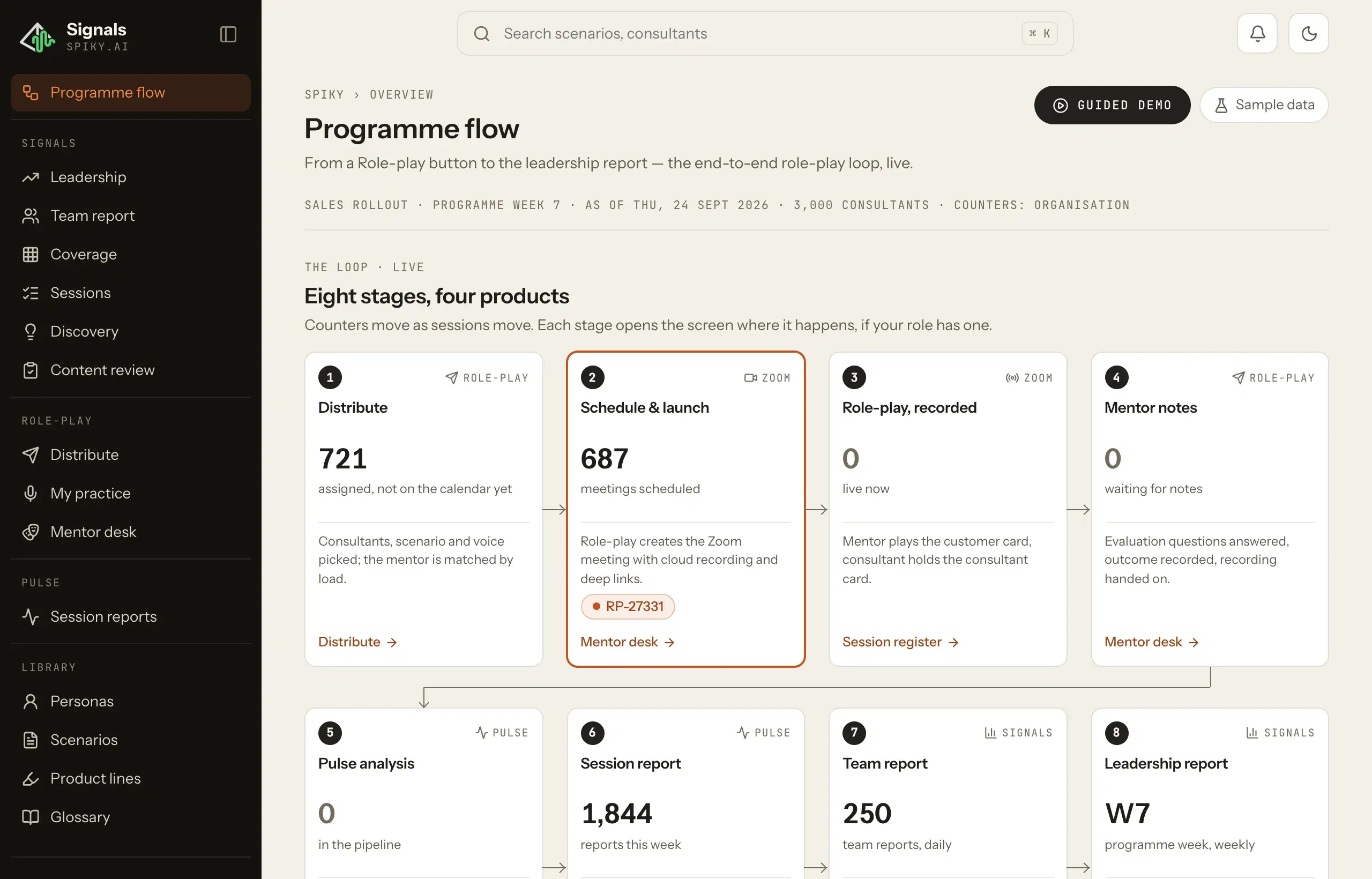













THE LOOP
Eight stages, four products, one program.
Each stage opens the screen where it happens, for the person who does it.
- ROLE-PLAY01
Distribute
Consultant, scenario and voice picked; the mentor matched by load.
- ZOOM02
Schedule and launch
Meeting created with cloud recording and deep links.
- ZOOM03
Role-play, recorded
The mentor plays the customer card; the consultant holds theirs.
- ROLE-PLAY04
Mentor notes
Evaluation questions answered, outcome recorded.
- PULSE05
Pulse analysis
Speech recognition, speaker separation, voice signals, scoring against the card.
- PULSE06
Session report
To the consultant and their own manager, minutes after the call.
- SIGNALS07
Team report
Who to coach this week, and on which customer type.
- SIGNALS08
Leadership report
Certification, readiness by region, the errors that keep coming back.
TRY A SESSION
Play a 30-second role-play.
You hold the consultant card. The customer’s situation and the mentor’s door are hidden from you, exactly as in a real session.
You are calling a busy closer.
Pulse scores the call as you play. The door stays hidden until the end.
FROM REAL CALLS TO THE LIBRARY
Practice what actually happens on your calls.
Scenarios are not written in a workshop. They are found in your calls.
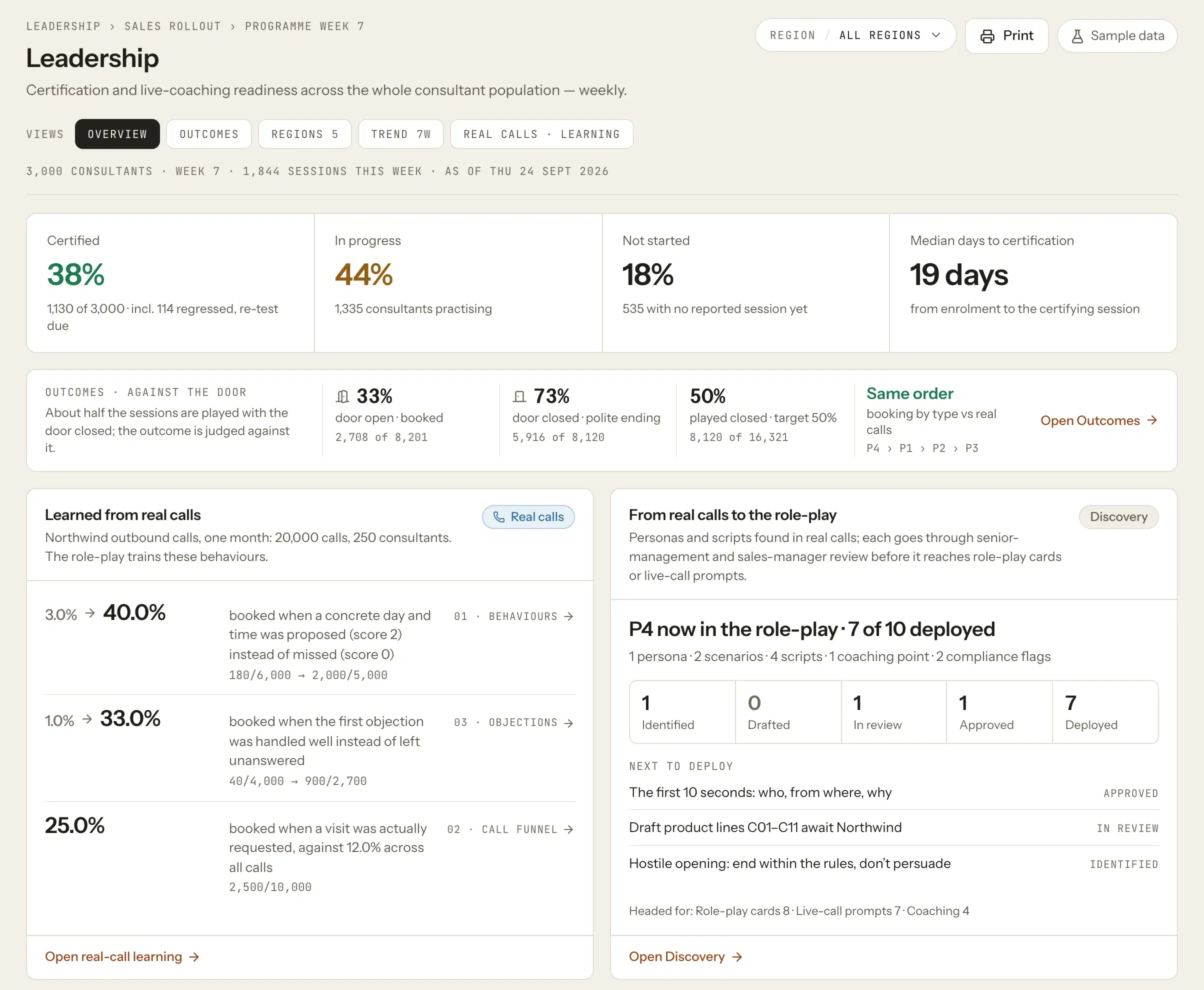
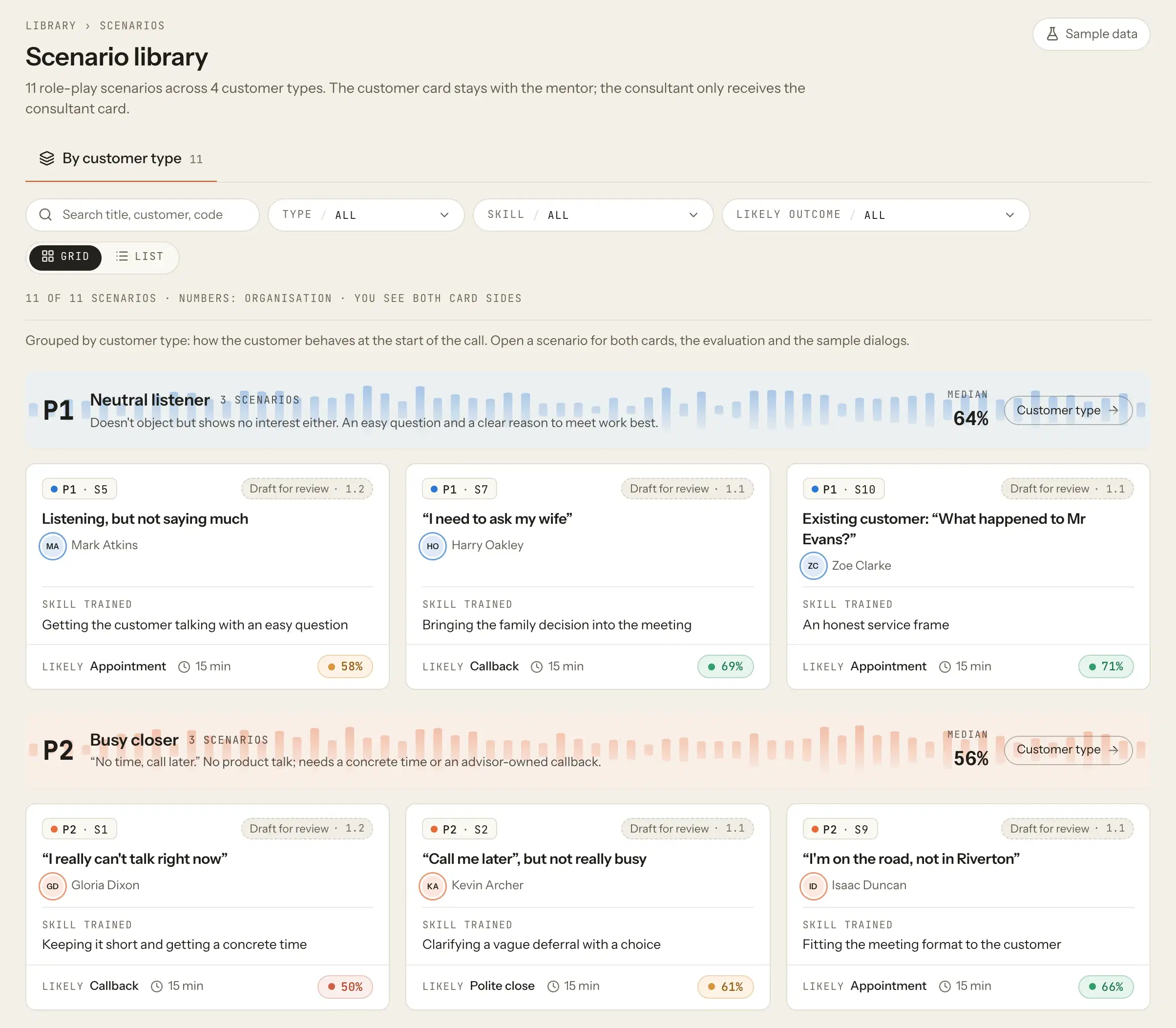
Spiky analyzes your real conversations and identifies the customer types, scripts and rules that decide whether a call books a meeting. Each finding shows the calls behind it, and goes to management before it reaches a role-play card.
- Customer types defined by how the customer behaves at the start of the call, not by who they are
- Every finding links to the calls behind it
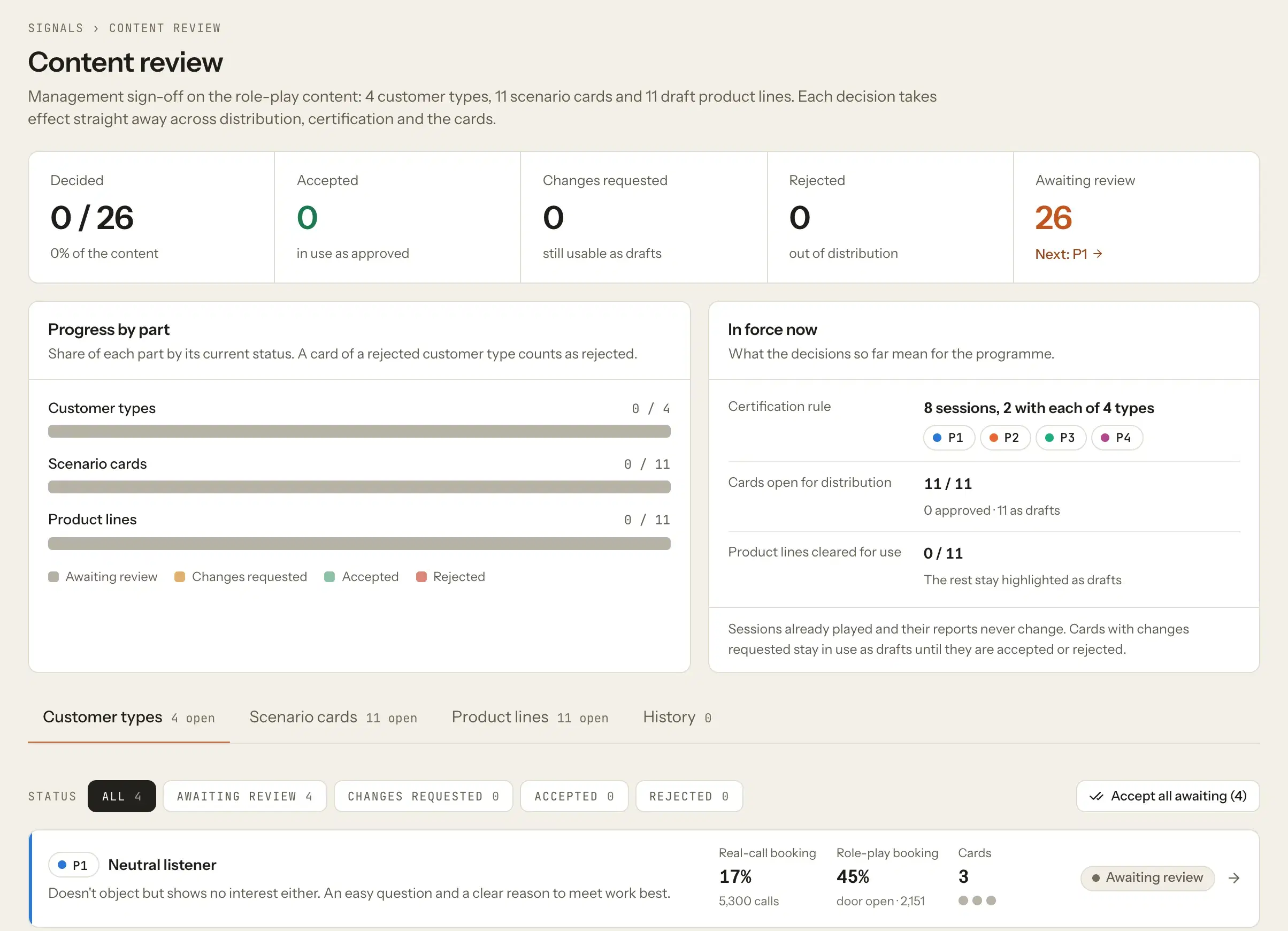
- Management accepts, requests changes on or rejects each item in content review
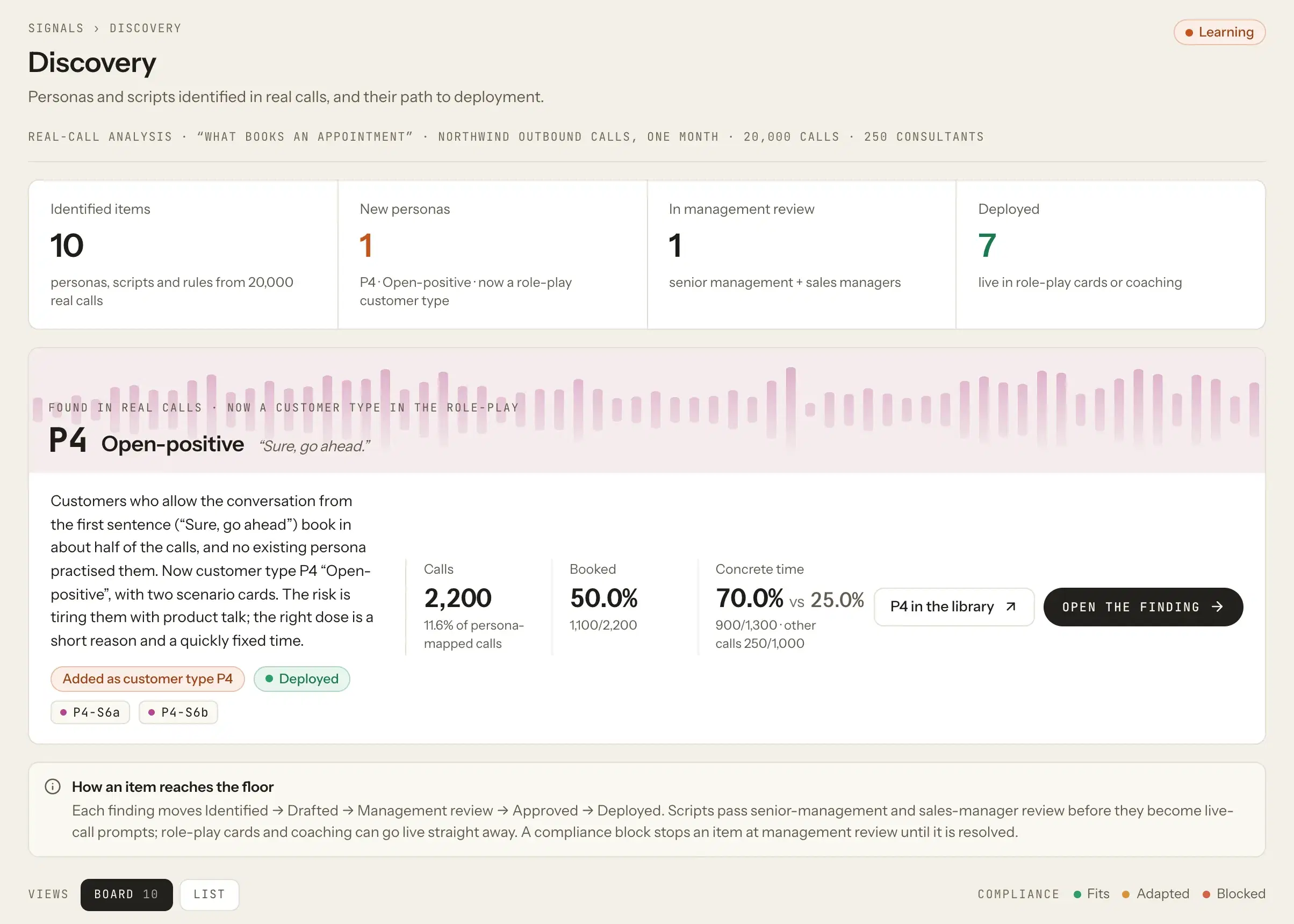
P1 · Neutral listener
Doesn’t object but shows no interest either.
P2 · Busy closer
“No time, call later.” No room for product talk.
P3 · Defensive objector
“Not interested, no budget.”
P4 · Open-positive
Allows the conversation from the first sentence.
EXAMPLE CUSTOMER TYPES · DEFINED BY HOW THE CUSTOMER BEHAVES AT THE START OF THE CALL
TWO CARDS AND A HIDDEN DOOR
Each side knows only what it would know on a real call.
The mentor plays the customer from the customer card. The consultant sees only their own card. The door decides what a good outcome is.
Your role, what is known about the customer, and the approach to take.
The customer’s situation, priorities and the voice to play.
The mentor picks open or closed before the session, and tells no one.
The score is call quality. The outcome is judged against the door: with the door closed, a polite ending is the right result.
The mentor plays the customer, in the voice on the card.
Mentors get a queue with the scenario and the voice to play. They choose the door before each session, play the customer from the customer card, and answer the evaluation questions when the call ends.
- A queue sorted by live and awaiting-notes sessions first
- The door chosen before the call, never shown to the consultant
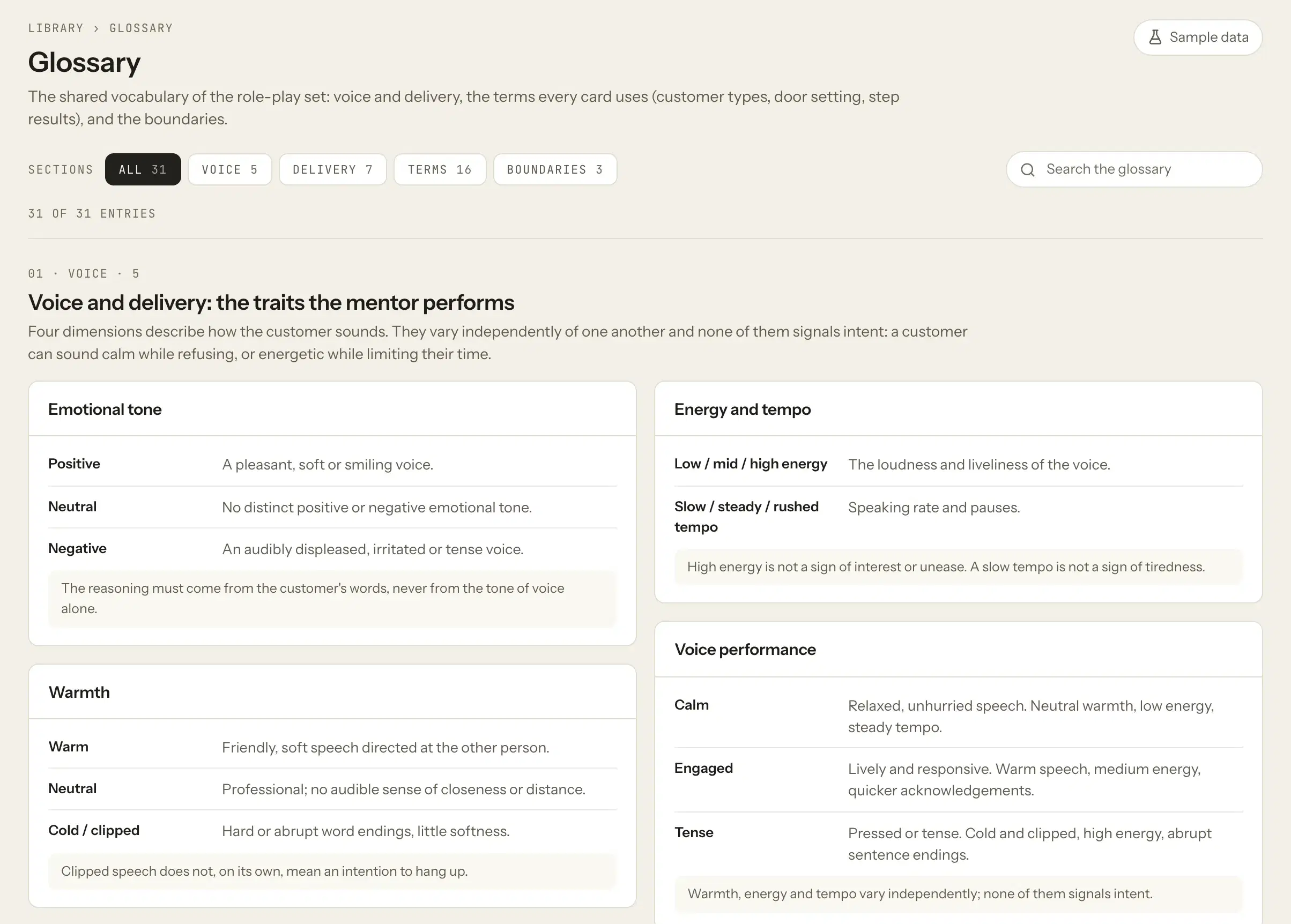
- Three voices to perform: calm, engaged and tense
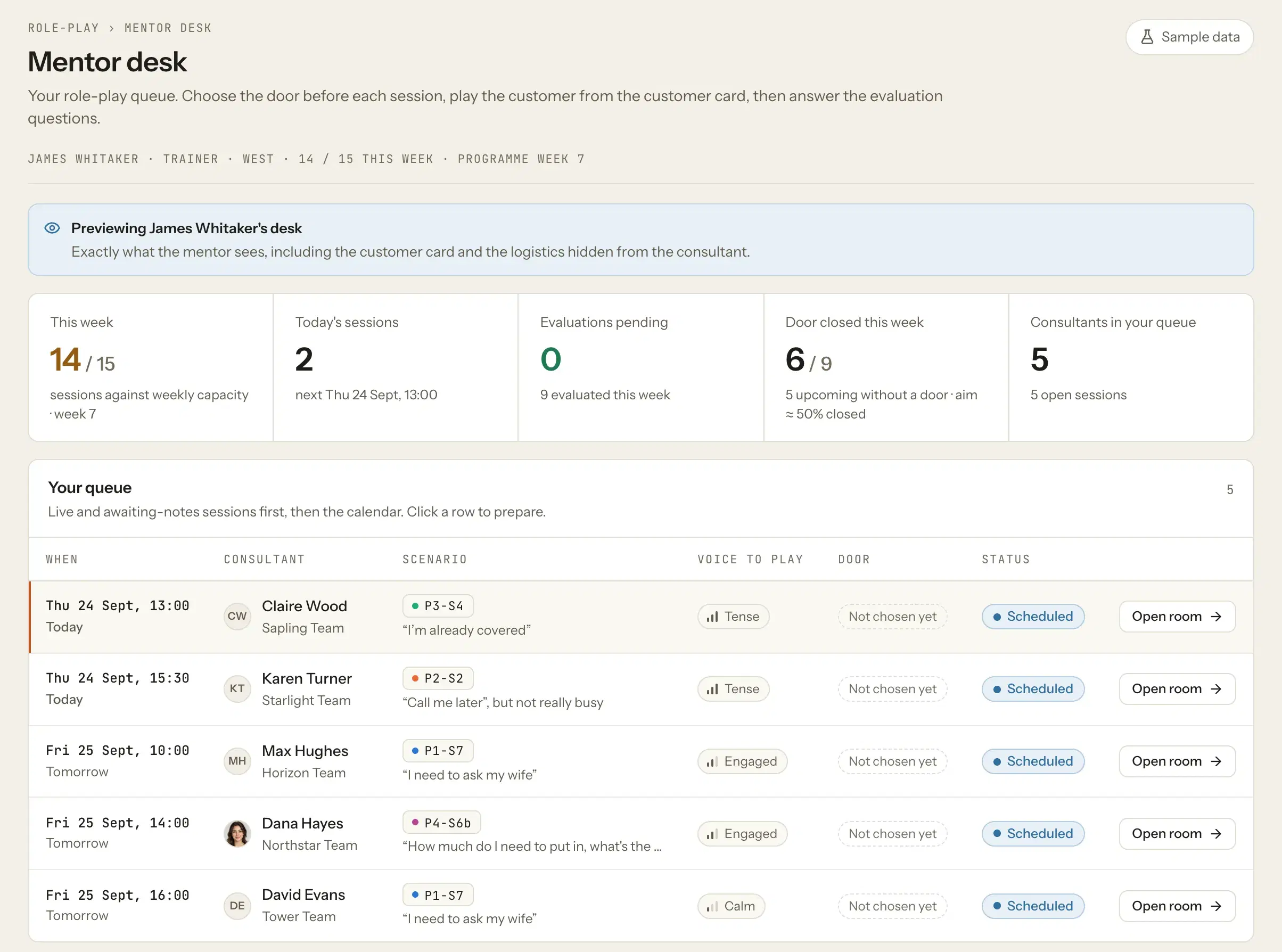
Relaxed, unhurried speech. Neutral warmth, low energy, steady tempo.
Lively and responsive. Warm speech, medium energy, quicker acknowledgements.
Pressed or tense. Cold and clipped, high energy, abrupt sentence endings.
A SCREEN FOR EVERY ROLE
Consultant, mentor, manager, leadership, program admin.
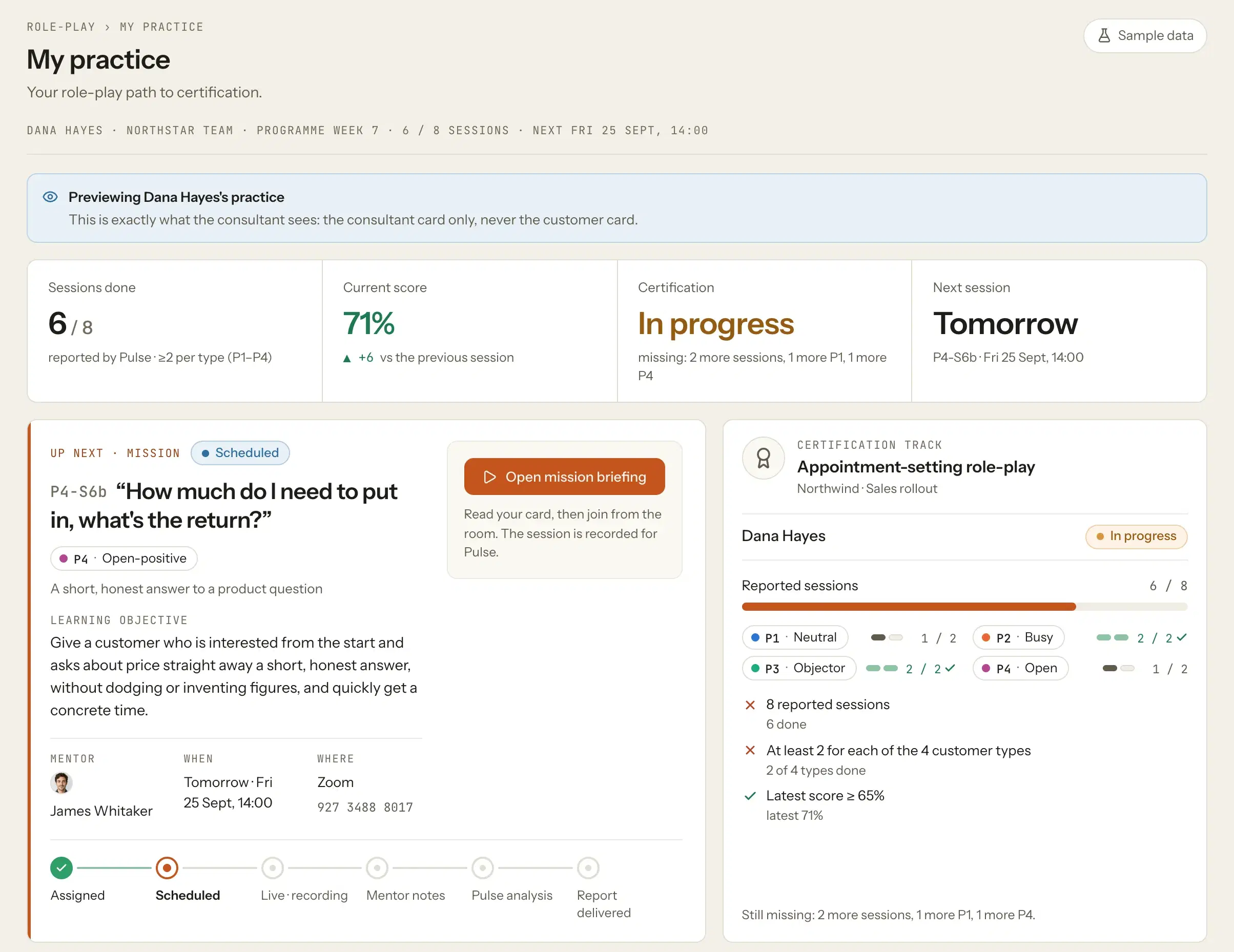
Consultant
The next mission, the learning objective, the mentor and the Zoom room, plus what is still missing for certification.
Mentor
A queue, a door to choose, a customer to play, and evaluation questions afterwards.
Manager
Who to coach this week and on which customer type, and the next scenarios to send.
Leadership
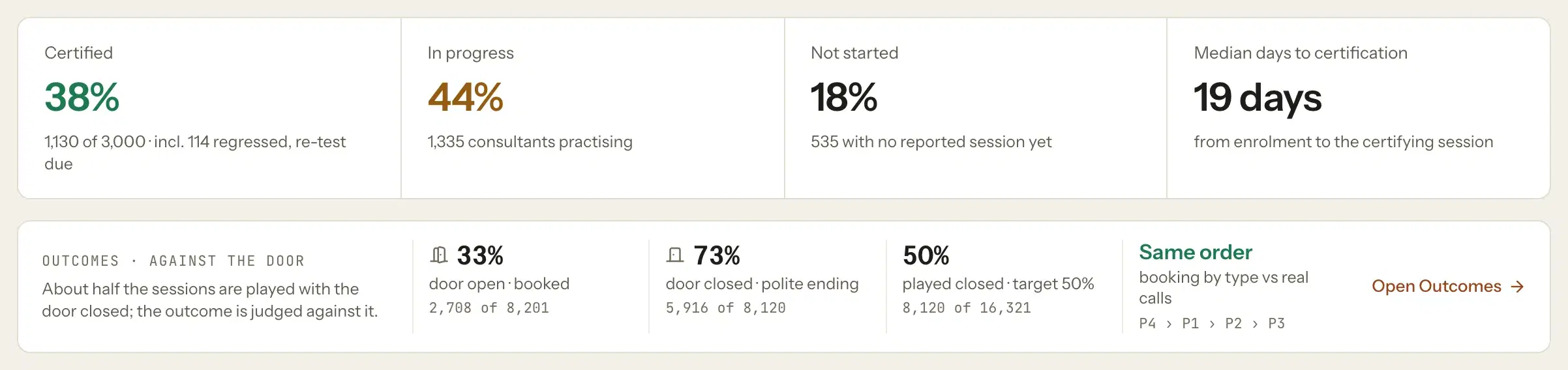
Certification across the population, outcomes against the door and readiness by region.
Program admin
Content review, the scenario library, product lines and the rules every report is computed with.
REPORTS
Reports that tell people what to do next.
Scored minutes after the call, against the card that was played.
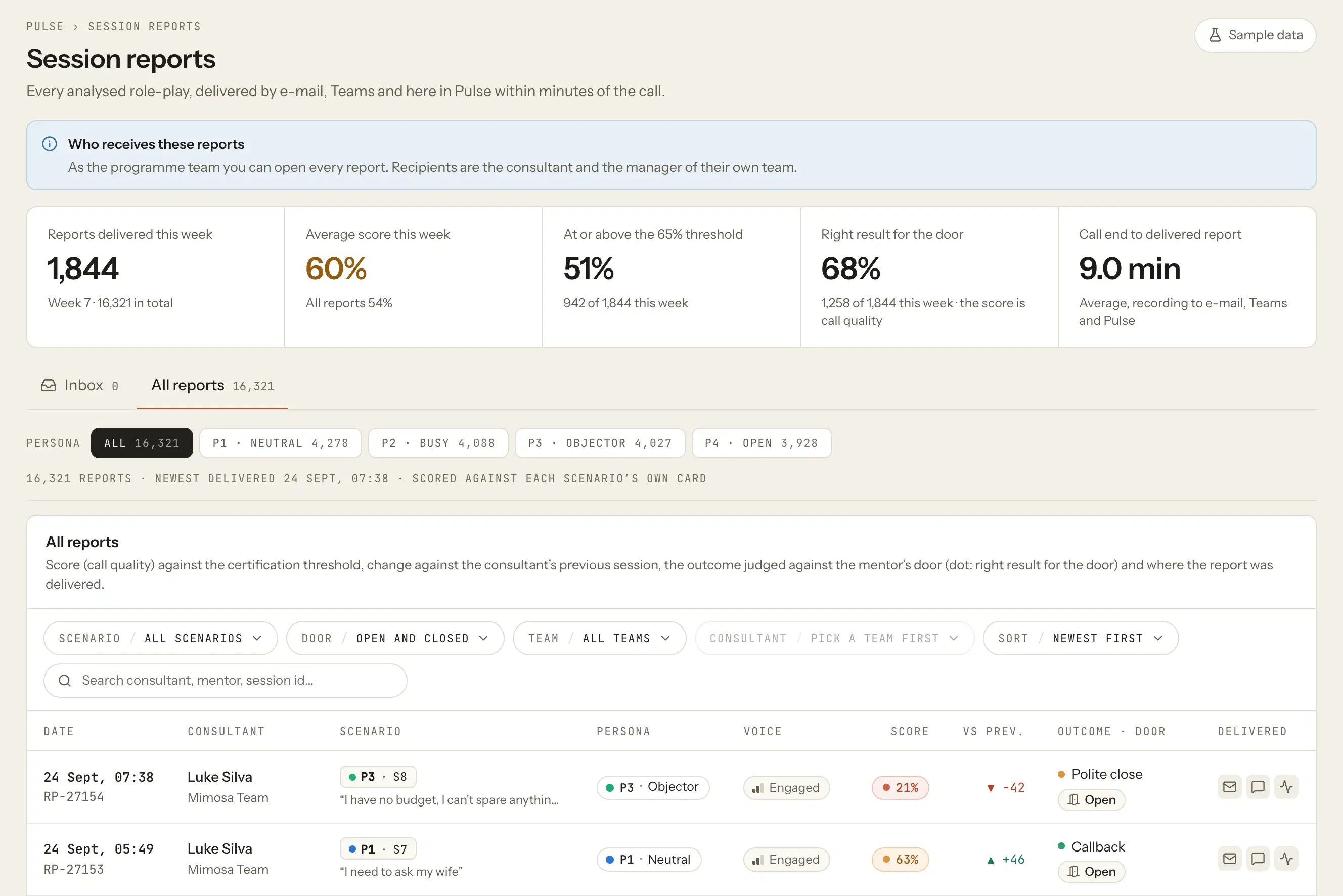
Pulse transcribes the Zoom recording, separates the speakers, reads the voice signals and scores the session against its scenario card. The report reaches the consultant and their own manager by e-mail, Teams and in Pulse.
- The score measures call quality
- The outcome is judged against the mentor’s door
- Each report compared with the consultant’s previous session
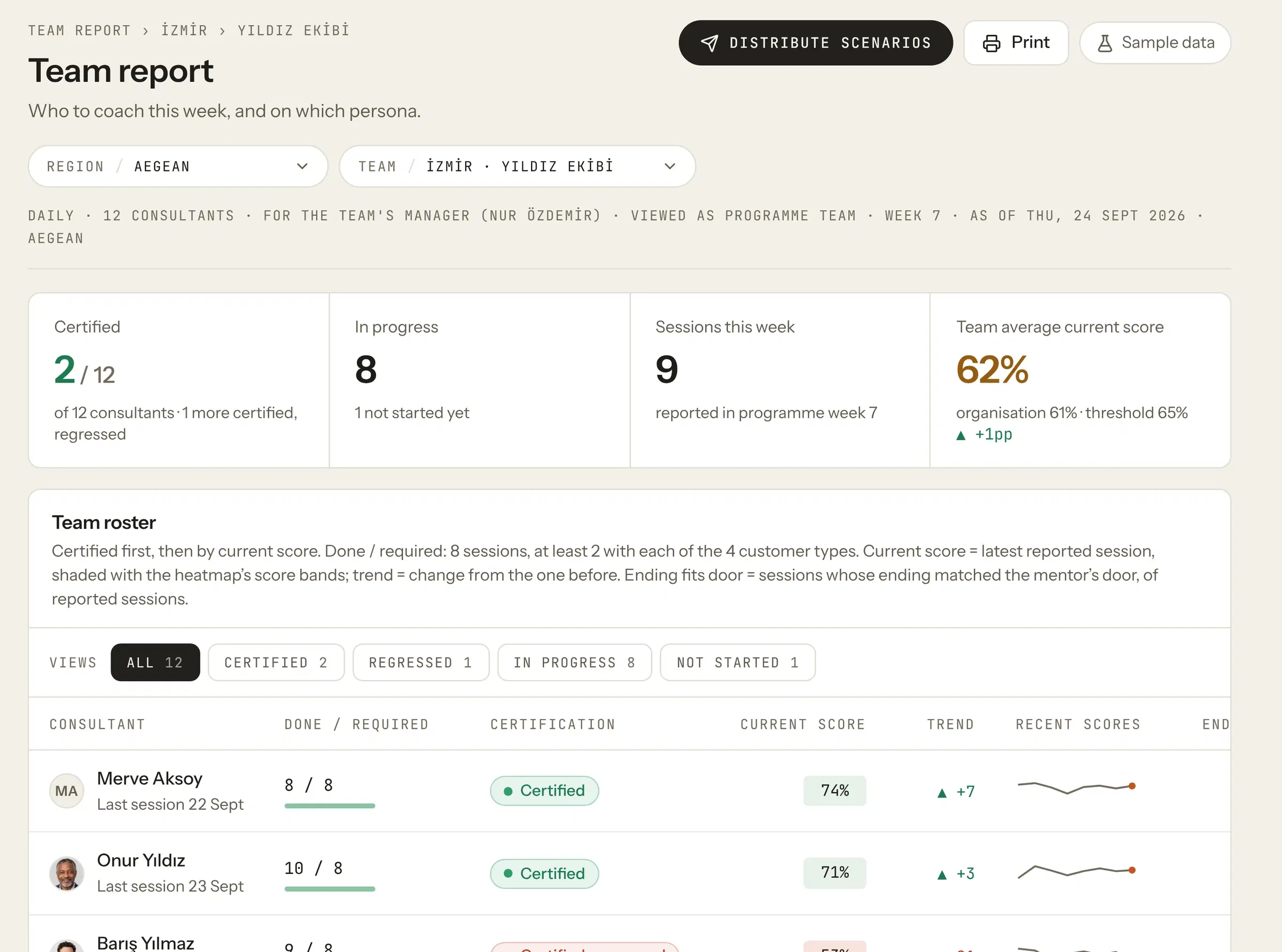
Who to coach this week, and which regions are ready.
The team report ranks every consultant by certification and current score, with the trend and recent scores. The leadership report rolls the program up by region, customer type and outcome.
- Daily team report for managers
- Weekly leadership report for the program
- A consultant × scenario coverage matrix
ONE SCORE, FOUR DECISION LAYERS
Every layer answers the same score differently.
LEADERSHIP REPORT · SAMPLE DATA
Pulse
Minutes after the sessionWhich scenario to schedule next, chosen by the weakest part of the call.
Signals · daily
To the team managerWho to coach this week and on which customer type.
Signals · weekly
Across the populationWhich teams have passed the readiness threshold.
Spiky Whisper
During real callsCoaching the next sentence on real calls, once a region is ready.
CERTIFICATION
A clear path, and rules everyone can see.
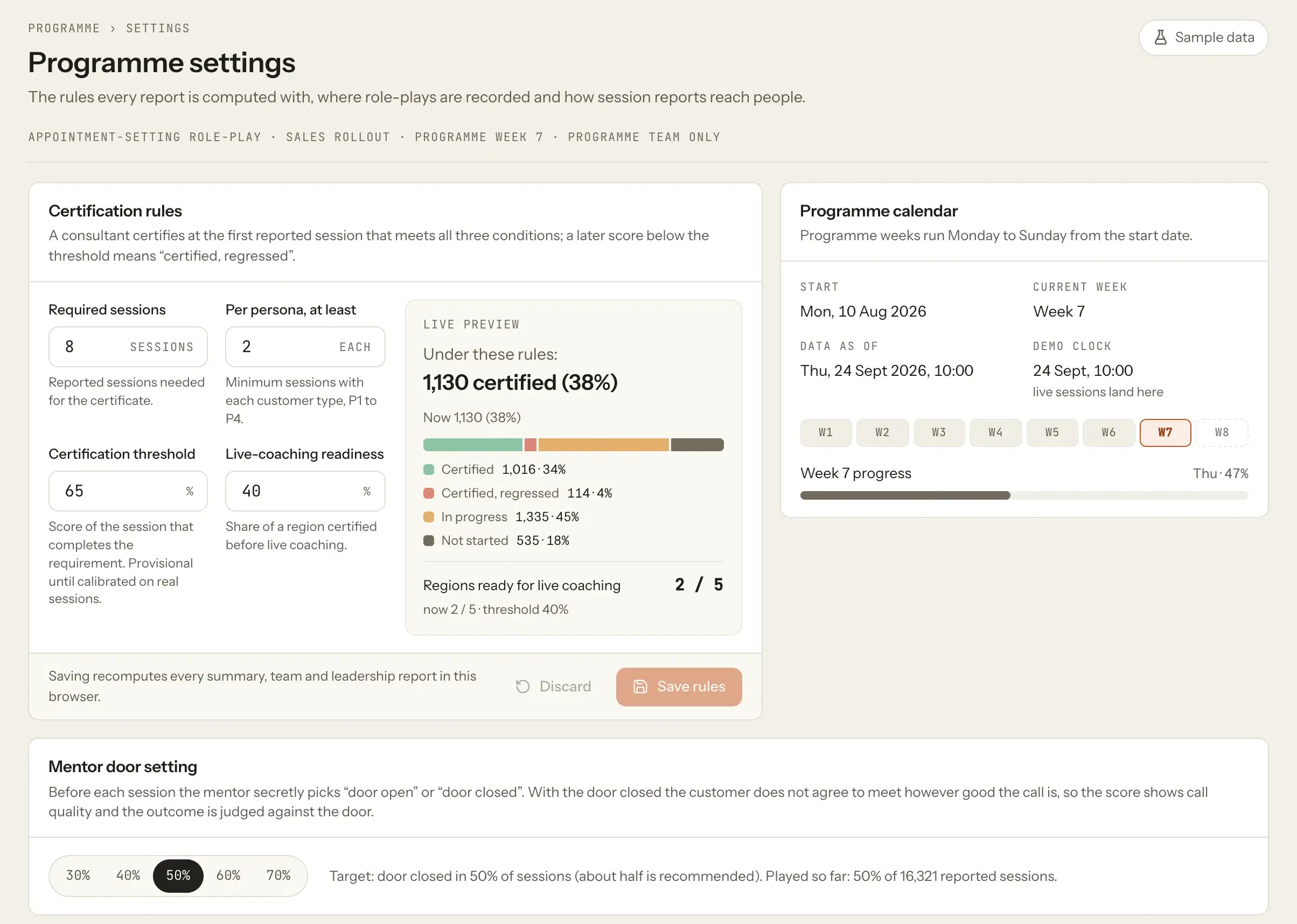
Rules you set once. Every report follows them.
Each program sets its own certification rules, for example a number of reported sessions, a minimum with every customer type, and a score threshold. A live preview shows how many consultants certify under the rules before you save them.
- Required sessions, sessions per customer type and the threshold
- A readiness threshold for moving a region to live coaching
- Sessions already played keep their reports when rules change
THE LIBRARY
Customer types, scenarios, product lines, glossary.
SCENARIO LIBRARY · GROUPED BY CUSTOMER TYPE
One vocabulary for mentors, managers and consultants.
Customer types, scenarios, product lines and a glossary of voice and delivery terms, side by side in both languages.
NEXT
From practice to live calls.
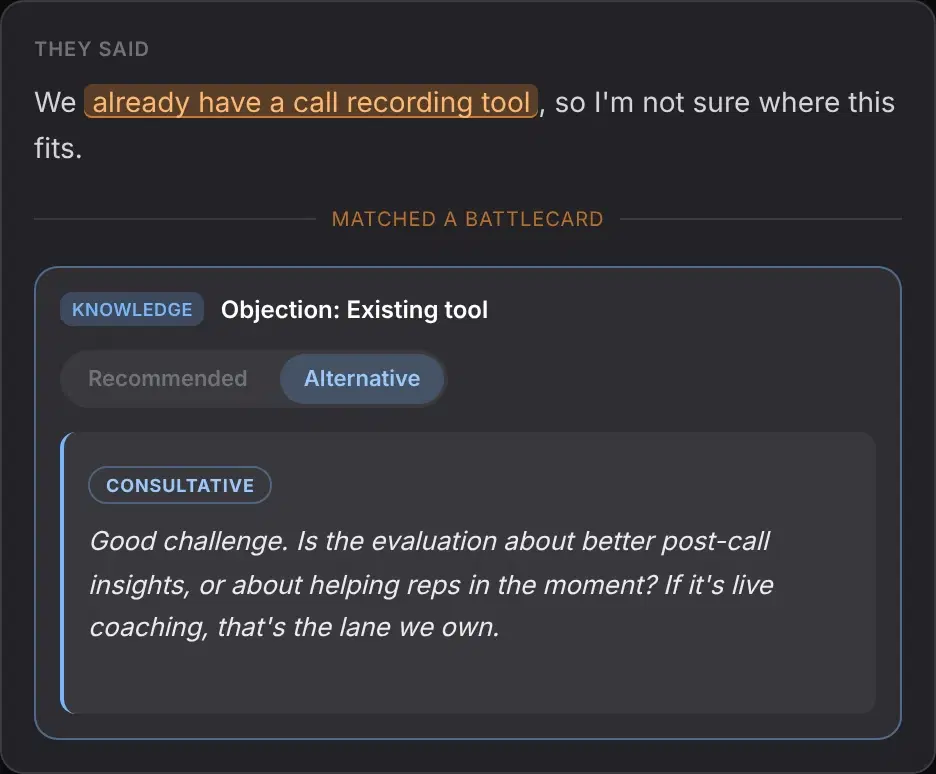
When a region is ready, the coaching moves onto real calls.
Spiky Whisper brings the same customer types and the same guidance into live calls, as a private dock on the consultant’s screen.
PART OF THE SPIKY PLATFORM
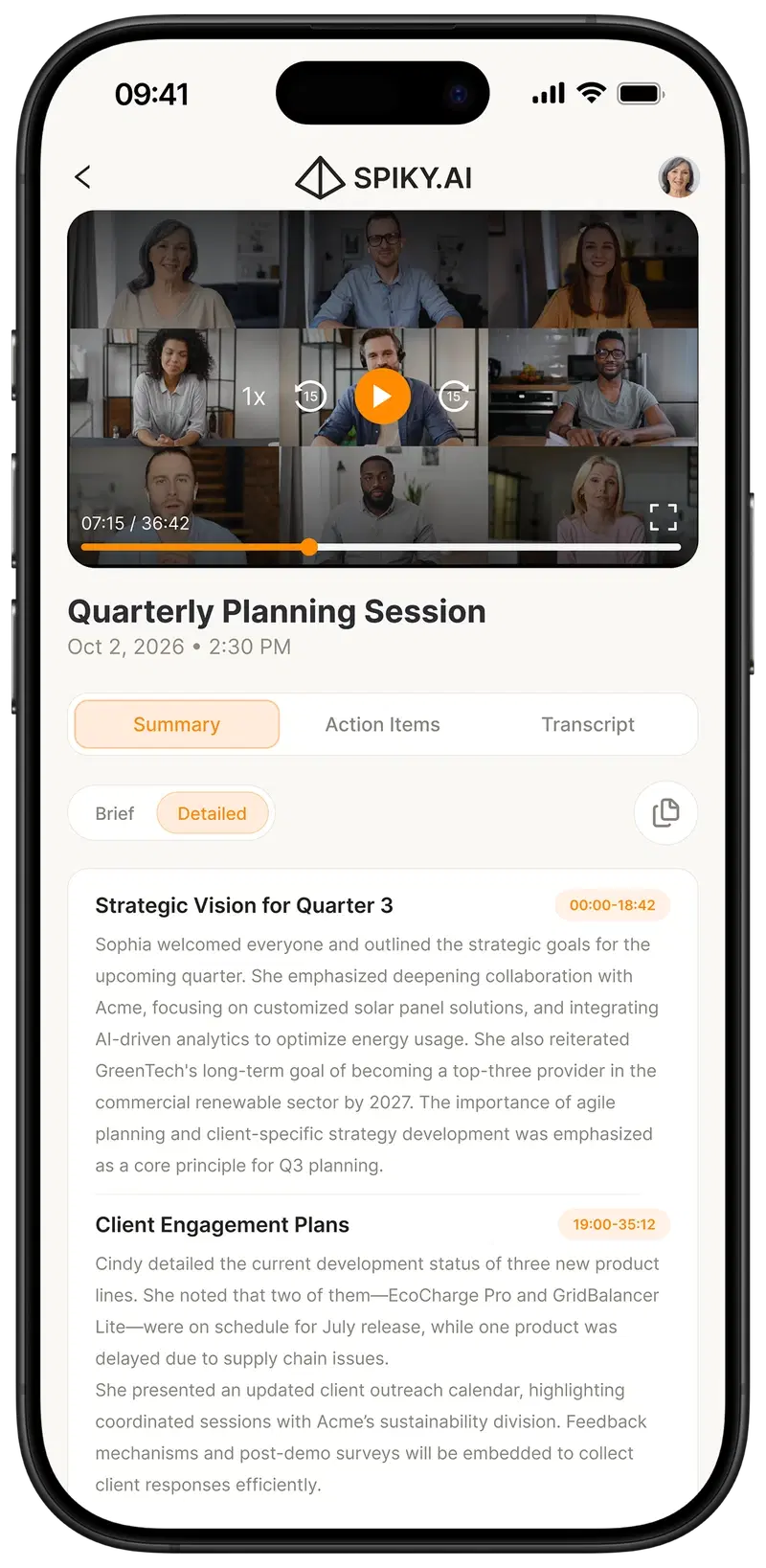
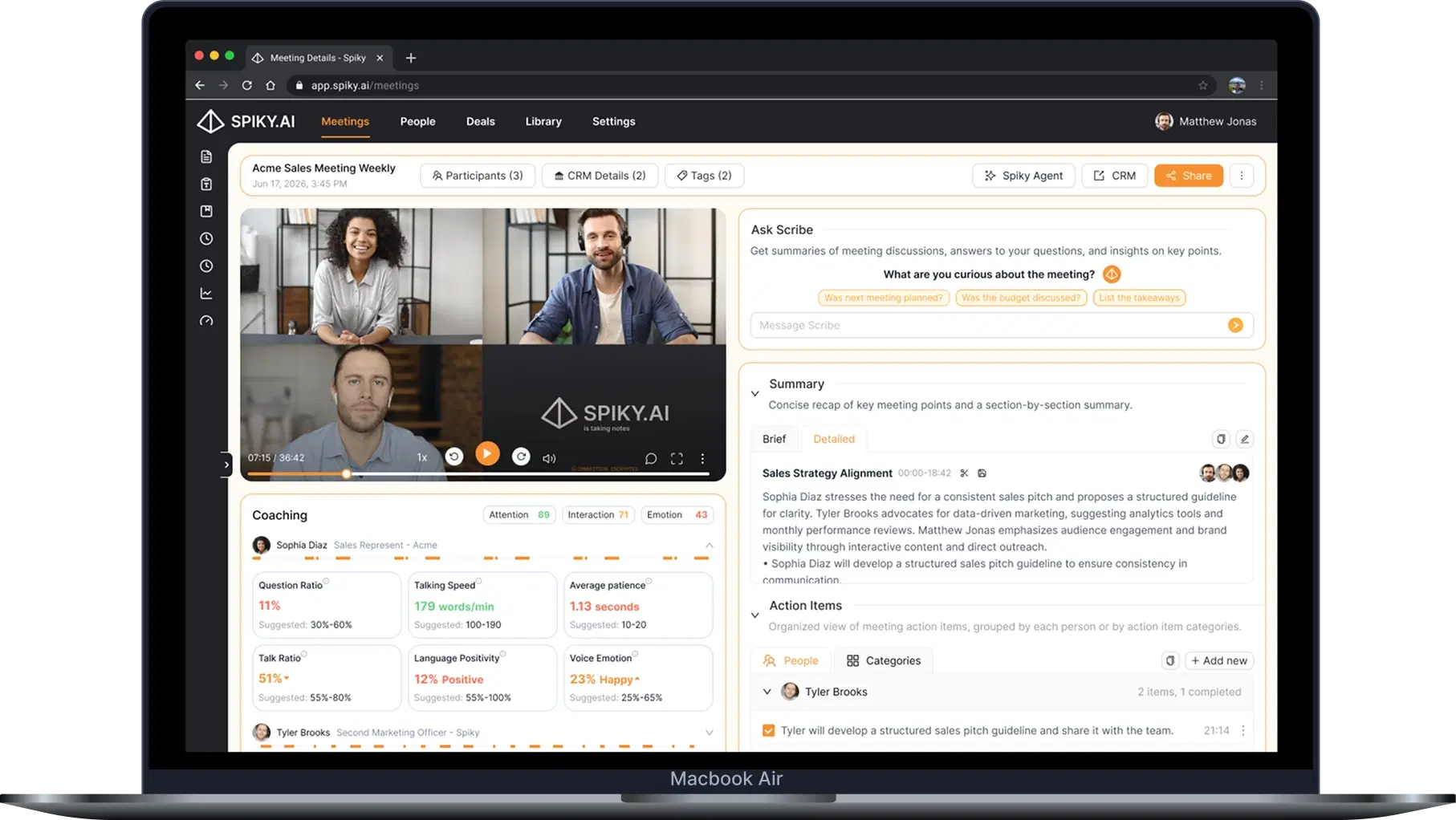
One account, every conversation.
FAQ
How the program works.
What is Spiky Role-play?
A role-play program built from your real calls. Customer types and scripts found in real conversations become scenario cards. Sessions run on Zoom with a mentor, Pulse scores every recording, and Signals rolls the results into team and leadership reports.
Is this an AI role-play simulator?
No. A human mentor plays the customer, from a customer card. AI does two other jobs: it finds the customer types and scripts in your real calls, and it scores each recorded session.
Where do the scenarios come from?
From your own calls. Discovery identifies customer types, scripts and rules in real conversations; management accepts, requests changes on or rejects each one before it reaches the role-play cards.
Who plays the customer?
A mentor, from the customer card and in the voice it specifies. The consultant only sees the consultant card, so the conversation stays realistic.
What is the door?
Before each session the mentor secretly chooses whether the door is open or closed. The score measures call quality; the outcome is judged against the door. With the door closed, a polite ending is the right result.
How are sessions scored?
Pulse analyzes the Zoom recording with speech recognition, speaker separation and voice signals, and scores it against the scenario card. The report reaches the consultant and their own manager by e-mail, Teams and in Pulse, minutes after the call.
How does certification work?
Each program sets its own rules, for example a number of reported sessions, practice with every customer type, and a latest score above a threshold.
Which languages does it support?
The workspace runs in English and Turkish.
What comes after role-play?
Live coaching on real calls through Spiky Whisper, once a region passes its readiness threshold.
FROM PRACTICE TO LIVE CALLS
Build a role-play program on your own calls.
Turn your real conversations into customer types, scenario cards and a certification path every manager can see.